

A technician tops up a gearbox and marks the work order complete. A week later, the same gearbox needs attention. Can the maintenance team tell how much oil was added, which grade was used, and whether the job was a top-up or a full refill?
On an automated line, the question is different. A controller may have called for a lubrication cycle, but did oil pass through the branch serving the intended lubrication point?
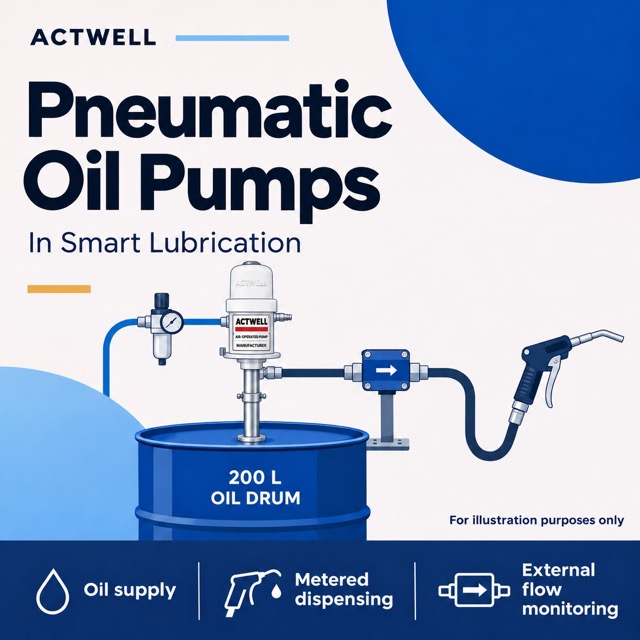
A pneumatic oil pump serves as the oil supply component in these applications. It transfers oil from a drum or tank to a dispensing point or lubrication line. Additional information, such as dispensing volume, oil flow, and machine condition, requires separate measuring instruments and monitoring equipment.
At a service station, this can start with a metered oil gun and a work order. In a centralized lubrication system, it may involve external flow sensors, a controller, and machine condition monitoring devices selected and installed separately.
Where an Air Operated Oil Pump Fits in Smart Lubrication
Actwell’s F80, J80, and L80 are fixed-mount pneumatic oil pumps designed for standard 200 L drums, with pressure ratios of 5:1, 9:1, and 15:1, respectively.
For applications requiring measured oil dispensing, Actwell also offers the 940735M oil gun with meter, which allows technicians to measure the volume of oil dispensed during each service operation.
These products provide the oil delivery and dispensing functions within a lubrication setup. Additional functions, such as automatic flow monitoring, alarm notifications, and machine condition monitoring, require separate instruments and control systems supplied and configured independently.
Actwell's role is to provide reliable oil transfer equipment that can be incorporated into a wider lubrication system.
View Actwell F80/J80/L80 specifications
Equipment Used in a Smart Lubrication Setup
| Equipment | Function | Information Available |
|---|---|---|
| Actwell Pneumatic Oil Pump | Transfers oil from a drum or tank to a dispensing point or supply line. | Pump model, pressure ratio, and oil supply configuration. |
| Actwell Metered Oil Gun | Measures the volume of oil dispensed through the gun. | Oil volume dispensed during each service operation. |
| External Oil Flow Sensor | Detects oil passage or measures flow at a selected point. | Oil flow information at the monitored location. |
| External Controller and Alarm | Processes sensor signals and generates alerts based on system settings. | Abnormal or missing flow signals. |
| Machine Condition Monitoring Equipment | Monitors machine parameters such as vibration and temperature. | Changes in machine operating condition. |
Note: Actwell pneumatic oil pumps and metered oil guns provide oil transfer and dispensing measurement functions. External sensors, controllers, alarms, and machine monitoring equipment are separate components and are not built-in features of Actwell pumps.
Metered Oil Dispensing: Start with One Service Station
A vehicle service bay or factory maintenance station can start by recording the oil dispensed on each job. With a metered oil gun such as the Actwell 940735M, the technician reads the dispensed volume and enters it on a paper work order or in a spreadsheet. Include the equipment ID, oil grade, service date, and whether the job was a top-up or a complete refill. View the Actwell 940735M oil gun with meter
Consider two service records for the same gearbox. One shows 2.0 L, and the other shows 2.8 L. Those are illustrative readings. To understand the difference, check whether the gearbox started at the same oil level and whether both technicians followed the same fill procedure. If the jobs were comparable, the difference gives the maintenance team a specific reason to review the equipment and its service history. The machine manufacturer’s fill procedure and level checks determine the correct fill.
If one oil gun serves several machines, record the equipment ID at the time of dispensing. Use the same unit across work orders so the team can compare like-for-like jobs without having to reconstruct which machine was serviced or how the reading was taken.
Oil Flow Monitoring: Verify Delivery at a Critical Point
In a centralized lubrication system, a main line may supply several branches. A reading at the pump outlet tells you what passed through that measuring location. To verify delivery to a particular branch, the measurement needs to represent the branch or the lubrication point it serves. Some sensors detect the passage of a small dose of oil. Others measure flow rate or volume within a specified range.
Suppose a controller calls for a lubrication cycle and one branch fails to return the expected signal. The maintenance team can compare that result with the cycle timing and the signals from nearby branches. If the other branches report as expected, the affected branch is a sensible place to start checking. Possible causes include a restriction, an interruption in supply, or a sensor or wiring fault.
Before selecting an instrument, review the expected flow, oil viscosity at operating temperature, pressure, connection sizes, and timing of any intermittent doses. Document which branch or point each sensor represents. This gives technicians a clear inspection location when an alarm appears.
Predictive Maintenance: Read Lubrication and Machine Data Together
Predictive maintenance is achieved through the integration of separate monitoring equipment and maintenance records, rather than through the pneumatic oil pump itself.
A maintenance team can use lubrication records alongside machine condition data to decide when and where to inspect. For example, if a bearing’s vibration trend changes, a technician can review recent work orders and available flow records for the same asset.
The pneumatic oil pump provides the oil supply, while external monitoring devices collect the information needed for further analysis. Comparing these records at similar operating speeds and loads helps the team determine when a change began and whether it coincided with a missed lubrication event.
A maintenance team can use lubrication records alongside machine condition data to decide when and where to inspect. For example, if a bearing’s vibration trend changes, a technician can review recent work orders and available flow records for the same asset. Comparing readings at similar speeds and loads helps the team determine when the change began and whether it coincided with a missed lubrication event.
If the records show an interruption in oil delivery, the technician can check the lubrication path as part of the inspection. If delivery records are consistent, the investigation can include operating conditions, alignment, and the bearing itself. In both cases, the records help the team decide what to check first.
Give the lubrication and condition records a common equipment ID and consistent timestamps. Include the measurement location so the team can distinguish a reading taken at the pump outlet from one taken near the bearing. Industrial systems that combine bearing condition monitoring with automatic lubrication illustrate how these records can support maintenance decisions.
Condition-assisted lubrication technical reference
How to Start a Smart Lubrication Pilot in Five Steps
- Choose one service station or lubrication point. Start with a recurring job that gives you enough records to compare, or a critical point where delivery is difficult to verify.
- Decide what you need to measure. Define whether you need the volume dispensed per job, confirmation of oil flow at a specific point, or a lubrication record you can compare with machine condition data.
- Match the tool to the measurement. Consider a metered oil gun for manual dispensing or a suitable external sensor for a specific line measurement. Check the oil, pressure, flow range, and fittings before selecting components.
- Record a baseline. Capture the equipment ID, date, oil grade, and reading. For automatic cycles, also record the expected signal and when it should occur.
- Agree on how to respond. Assign someone to review unusual readings, check the relevant equipment under the site’s maintenance procedures, and record the findings.
At the end of the pilot, review whether the records answer the original question. At a service bay, check how many jobs have both an equipment ID and a usable volume reading. On an automated line, see whether the team can match each expected lubrication event with a recorded signal and account for missing readings. If a reading is difficult to interpret, revisit the measuring location or the recording procedure.
FAQ|About Smart Lubrication and Pneumatic Oil Pumps
Choose Actwell for Reliable Lubrication Solutions
Planning an oil dispensing station or upgrading your existing lubrication setup?
Actwell provides pneumatic oil pumps and metered oil guns for industrial oil transfer and dispensing applications.
Send us your oil grade, drum or tank dimensions, available air pressure, current pump model, and fitting sizes. Let us know your required oil delivery rate and dispensing method so we can help identify a suitable pump and oil dispensing solution.
For applications requiring automated flow monitoring or machine condition monitoring, these functions should be specified separately as part of the overall system design.